One Vendor for All Your Organic Waste Streams


Key Takeaways
- Managing food waste, used cooking oil collection (UCO) and recycling and grease trap service through separate vendors creates coordination gaps that compound across locations
- Vendor fragmentation means inconsistent scheduling, split accountability, and reporting that never gives you the full picture
- Multi-location operators feel this most acutely — what's manageable at one site multiplies fast across a portfolio
- A single partner with cross-service capability simplifies scheduling, documentation, and day-to-day accountability
- Denali provides food waste recycling, depackaging, UCO collection, and grease trap service under one program.
People love convenience. That’s why grocery stores often add a pharmacy or coffee shop to their locations, and why hotels have on-site gyms and restaurants.
All-in-one convenience is just as important in business. Having access to multiple service streams through one vendor saves time and, often, money. Let’s take a look at how building a strong relationship with a single, high-quality organics waste service provider can benefit your commercial food operation.

The operational problems of managing multiple organic waste vendors
Separate vendors don't just mean separate relationships — they create specific pain points where things can go wrong.
Missed pickups with no clear owner
When food waste collection, UCO, and grease trap service run on independent schedules, a change with one vendor can create a backlog that nobody catches until it's a back-of-house problem. There's no single point of contact with visibility across all three streams, so issues don't get flagged until there’s a problem.
When something goes wrong, no one owns it
When a pickup is missed or documentation is incomplete, each vendor is responsible for their piece and nobody owns the full picture. For operations with compliance reporting requirements, incomplete documentation is a liability.
Organic waste landfill diversion reporting breaks down
Tracking landfill diversion performance across multiple vendors means working with multiple reporting systems. At the end of every reporting cycle, someone on your sustainability or operations team is manually pulling numbers together — a time-consuming process that a consolidated vendor relationship would eliminate.
Compliance errors are harder to catch
Organic waste regulations vary by state and are in a constant state of change. When each stream is managed separately, there's no partner tracking the full compliance picture. Permit changes, updated documentation requirements, and new organics mandates can slip through unnoticed until they result in a violation.
What consolidation looks like in practice
Consolidating organic waste recycling services means working with a partner whose service lines are deep enough to handle each stream properly and integrated to manage them as a single program.
For most commercial food operations, the core services needed typically include:
Food waste recycling and depackaging
This is the anchor service for most food operations. Denali collects organic materials like unsold food, production residuals, and prepared food, and diverts it into beneficial reuse streams including animal feed, compost, and renewable energy.
For packaged products, depackaging mechanically separates organic materials from packaging for a clean stream of material for recycling.
Palletized waste and liquid destruction
Denali provides compliant and documented collection and recycling of expired, damaged, or recalled food, and beverages to keep them out of landfills. From grocery stores to food manufacturers and distribution centers, having one partner helps streamline operations and makes it easy.
Used cooking oil collection
Restaurants, hotel kitchens, grocery delis, and institutional cafeterias generate UCO continuously. Denali's automated collection program keeps this valuable commodity moving efficiently, eliminating the need for manual coordination by staff and ensuring the oil is recycled into biofuel. Grease trap service
Grease trap maintenance is a compliance requirement for every operation with a commercial kitchen. Folding it into the same program as food waste and UCO collection means one schedule, one contact, and one consolidated service documentation.

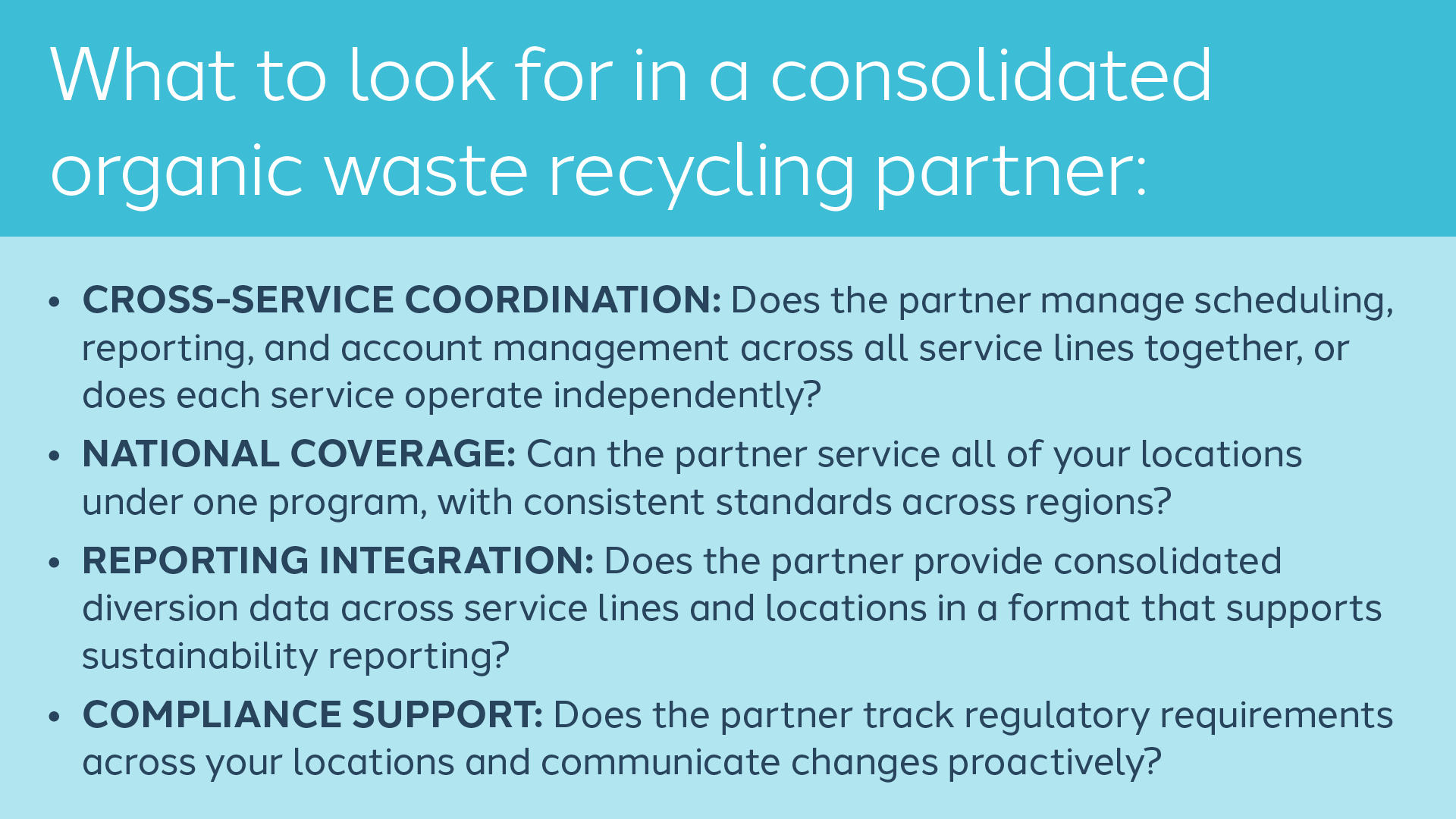
What to look for in a consolidated organic waste recycling partner
Not every provider can deliver on all-in-one convenience. A partner who offers multiple services but runs them as disconnected programs doesn't solve the coordination problem — it just moves it inside one vendor relationship.
A few things worth confirming before consolidating:
- Cross-service coordination: Does the partner manage scheduling, reporting, and account management across all service lines together, or does each service operate independently?
- National coverage: Can the partner service all of your locations under one program, with consistent standards across regions?
- Reporting integration: Does the partner provide consolidated diversion data across service lines and locations in a format that supports sustainability reporting?
- Compliance support: Does the partner track regulatory requirements across your locations and communicate changes proactively?
Denali provides food waste recycling and depackaging, palletized waste and liquid destruction, used cooking oil collection, and grease trap service — the full organic waste picture for most commercial food operations.
With a nationwide hauling network and owned recycling infrastructure, Denali can standardize organic waste recycling across locations without the coordination overhead of managing multiple vendor relationships.

Learn more about Denali’s services
Join thousands of businesses turning unsold food and organic waste into valuable new products. Partner with Denali for reliable service—and drive meaningful, sustainable impact.