What to look for in a food recycling partner


Key takeaways:
- The real test of a partner comes after launch — during expansion, staffing changes, and regulatory shifts
- Geographic coverage matters most for multi-location businesses
- Inconsistent pickup schedules can create compliance violations and public health risks
- Look for partners that offer ongoing training, reporting, and compliance monitoring
- Ask pointed questions about scalability before signing on
For companies investing in food recycling, the launch is only the beginning. The real test of a partner comes later during expansion, staffing changes, regulatory updates, or when operations are under pressure.
A food recycling program for grocers, restaurants, hospitality, schools and universities, and entertainment venues can deliver measurable gains in cost control, compliance, and environmental performance — but those gains depend heavily on the provider behind the program. The right provider brings the infrastructure, consistency, reporting, and regulatory insight needed to support your operation year after year.
In this guide, we outline what to look for in a food recycling partner so you can evaluate providers for long-term operational performance.
What sets a strong food recycling partner apart
Food recycling providers can transport organic materials and divert them to compost, animal feed, and natural fertilizers. That capability is foundational.
The differentiator lies in what supports the program around that service. As you evaluate potential partners, focus on the elements that determine whether your program will perform consistently across locations and over time.
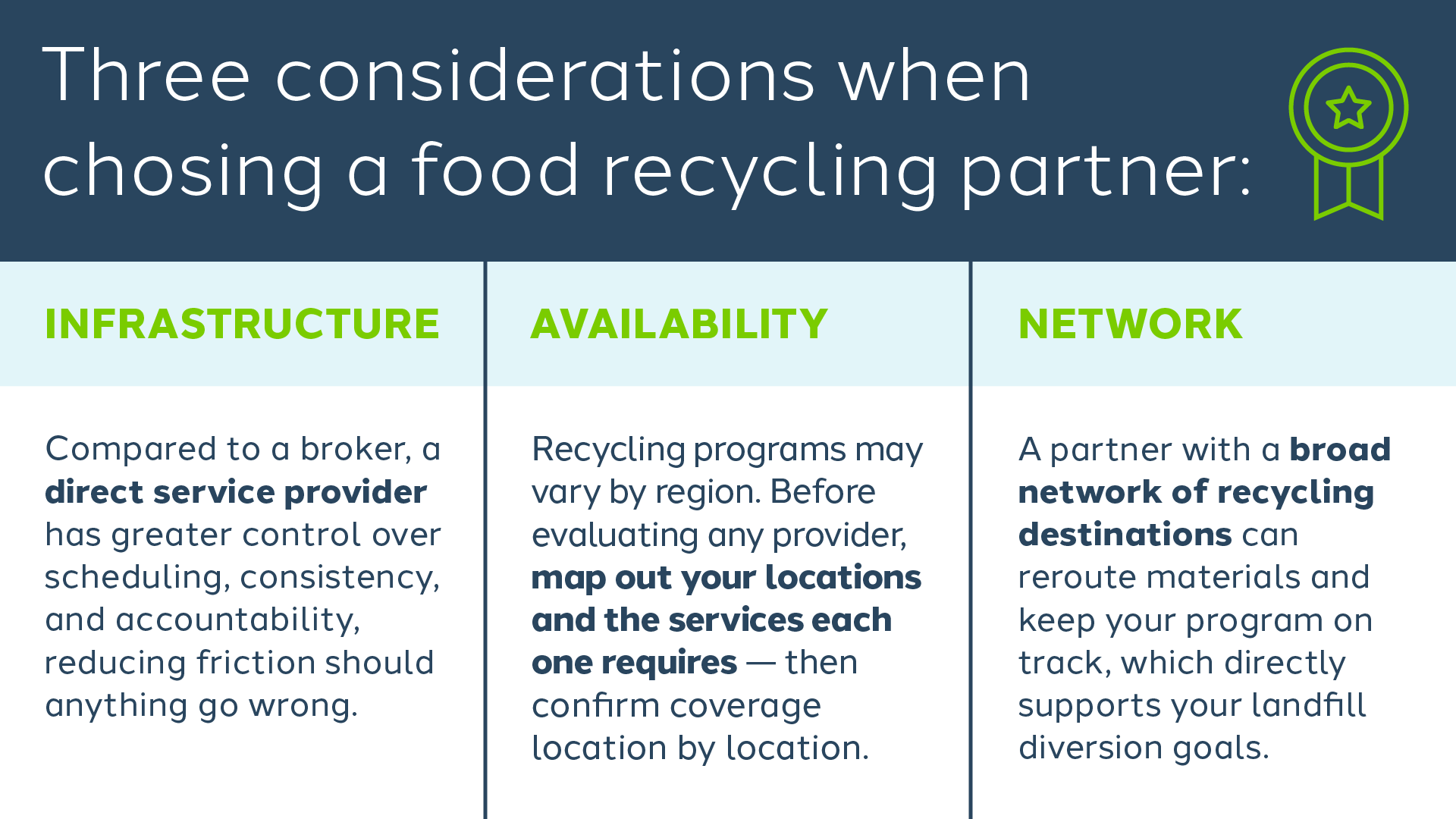
Start with these three areas:
Geographic coverage for multi-location food recycling programs
One of the first things to evaluate is the geographical coverage a recycling partner can actually support — not just where they operate, but how.
Infrastructure
Infrastructure matters here in a concrete sense: does the partner own and operate their own trucks and collection routes? Or are they a broker, sourcing vendors on your behalf? This distinction has real operational implications. A direct service provider has greater control over scheduling, consistency, and accountability. A broker introduces a layer of dependency that can complicate issues when something goes wrong.
Recycling program availability
It's also important to ask what specific food recycling programs are available in each area where you operate. A partner may offer composting in one region but not another. Before evaluating any provider, map out your locations and the services each one requires — then confirm coverage location by location.
Depth of network
Beyond coverage, consider what happens when a recycling destination becomes unavailable. A partner with only one outlet for your materials — one composting facility, one anaerobic digestion site — leaves your program vulnerable if that outlet experiences delays or disruptions. A partner with a broad network of recycling destinations can reroute materials and keep your program on track, which directly supports your landfill diversion goals even when circumstances change.
When evaluating geographic coverage, ask:
- What specific services are available at each of your locations?
- Is service standardized across regions, or does it vary?
- Do you provide collection services directly, or do you work as a broker?
- What happens to our materials if a recycling destination experiences delays or goes offline?
- Can you tell us where our recycled material goes?
- Can the partner scale coverage as you expand?
Service consistency and reliable food waste pickup
Nothing will torpedo a food recycling program like inconsistent service.
Inconsistent pickups can lead to:
- Backlogs of organic material
- Back-of-house issues with odor
- Compliance violations with fines ranging from hundreds to thousands of dollars
For these reasons, it’s imperative to have a food recycling partner that picks up on a regular schedule. You’ll also want to inquire about how the company communicates and what protocols it has in place for delays or issues with pickups.
Training, reporting, and compliance support for food recycling
A successful food recycling program should include services that support both the initial launch and ongoing maintenance. Important services to ask about are ongoing training support, reporting, and maintaining compliance requirements.
Training support — ensures that internal staff and management can run food recycling programs efficiently.
Reporting — helps demonstrate ROI, environmental gains, and other quantifiable KPIs.
Compliance monitoring — keeps your program aligned with evolving regional requirements.
A strong partner stays current on evolving standards and communicates changes clearly, helping you adjust your program as needed. This ensures your operation runs smoothly across markets without unexpected disruptions.
Questions to ask a food recycling partner
These questions will help guide a more informed conversation with potential food recycling partners:
- Do you provide collection services directly, or do you work as a broker?
- What geographic coverage do you provide, and is service standardized across all regions where you operate?
- How do you ensure pickup consistency and prevent service disruptions?
- Can you tell us where our recycled material actually goes, and what happens if that destination becomes unavailable?
- How do you verify weights and diversion data?
- What reporting capabilities do you offer, and how frequently is data provided?
- How is pricing structured?
- Do you support compliance documentation for audits or local mandates?
- How do you monitor and communicate regulatory changes that affect our locations?
- What training support is available at launch and as teams change over time?
- Can you share examples of how you've supported clients through expansion or operational changes?
Clear answers to these questions indicate whether a partner can deliver stability and accountability at scale.
Choosing a food recycling partner that supports growth
As your business expands into new markets, increases volume, or adjusts operations, your food recycling program must keep pace. Not every provider is built to scale alongside multi-location organizations.
When evaluating partners, look for evidence of infrastructure depth, regional coordination, and experience supporting companies through expansion. Ask how they’ve handled volume increases, new market entry, or operational shifts. Growth introduces complexity. Your partner should already have systems in place to manage it.
Building long-term operational confidence in your food recycling program
A strong food recycling partner demonstrates stability, standardized processes, and the ability to adapt without disruption. That foundation allows your team to focus on core operations while the program performs reliably in the background.
Denali supports more than 9,000 businesses across 48 states and Puerto Rico with scalable food recycling programs designed for long-term performance. Connect with us to build a program that performs today and continues delivering value as your organization grows.

Learn more about Denali’s services
Join thousands of businesses turning unsold food and organic waste into valuable new products. Partner with Denali for reliable service—and drive meaningful, sustainable impact.